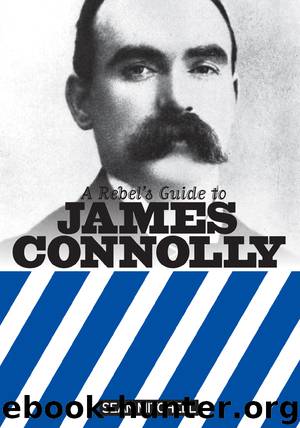
A Rebel's Guide to James Connolly by Sean Mitchell
Author:Sean Mitchell
Language: eng
Format: epub
ISBN: 9781910885109
Publisher: Bookmarks
* 7: CONNOLLY IN BELFAST
On 27 May 1911 James Connolly and his family moved to Belfast, settling in the Falls Road area of the city. Belfast was at this time an industrial powerhouse, with tens of thousands employed in its massive shipyards, engineering works and linen mills. The city was then, as now, deeply divided—its working class long scarred by the effects of sectarian enmity between Catholics and Protestants.
First appearances can, however, be deceptive: beneath this communal animosity was a rich history of trade unionism and working class militancy in the city. Just four years before Connolly’s arrival, for example, Belfast had been the scene of a mighty industrial upheaval which saw thousands of dock workers, led by Connolly’s frequent collaborator Big Jim Larkin, down tools in one of the biggest labour disputes in the city’s history. The strike went down to bitter defeat but its reverberations were still being felt when Connolly arrived in Belfast.
Connolly became central to radical politics and trade unionism in Belfast almost as soon as he arrived. He joined the Irish Transport and General Workers Union (ITGWU), and with Larkin’s support became its Ulster organiser. He was immediately in the thick of things, helping to recruit new members and leading a strike of 300 dockers for better pay and conditions (in sympathy with a strike happening simultaneously in Liverpool). Connolly’s years of experience and energy were central to the strike. He spoke at nightly meetings at Custom House Steps and organised a solidarity demonstration through the centre of the city. Symbolic of his successful efforts in fighting for class unity in the strike was convincing members of Catholic and Protestant Orange bands to play together and merge into a new band, later called the Non-Sectarian Labour Band. The strike was a significant success and the dockers won a number of concessions.
Connolly’s stature as a capable labour leader was quickly reinforced. In October of 1911 he was approached by a number of victimised women workers. They were employed in the local linen mills—where conditions for the overwhelmingly female workforce were harsh and pay abysmally low—who had been locked out by their employers for engaging in spontaneous strike action. The workers had had it up to their ears with the cruel treatment meted out by their bosses: they had been threatened with fines should they laugh, sing, talk or fix their hair during working hours. Their own union, the Textile Operatives Society, refused to support their action. But the linen workers found an ally in James Connolly, who urged them to set up a strike committee, helped them organise solidarity and spoke at their meetings, including one at St Mary’s Hall attended by over 3,000 people.
The strike was solid, but the bosses refused to negotiate. The women returned to work following Connolly’s advice, with one caveat: should one worker be reprimanded for singing then they should all sing; should one worker be reprimanded for talking then they should all talk; and if one worker walked out they all should walk out.
Download
This site does not store any files on its server. We only index and link to content provided by other sites. Please contact the content providers to delete copyright contents if any and email us, we'll remove relevant links or contents immediately.
| Elections & Political Process | Ideologies & Doctrines |
| International & World Politics | Political Science |
| Public Affairs & Policy | Specific Topics |
| United States |
The Secret History by Donna Tartt(19032)
The Social Justice Warrior Handbook by Lisa De Pasquale(12183)
Thirteen Reasons Why by Jay Asher(8885)
This Is How You Lose Her by Junot Diaz(6873)
Weapons of Math Destruction by Cathy O'Neil(6261)
Zero to One by Peter Thiel(5782)
Beartown by Fredrik Backman(5734)
The Myth of the Strong Leader by Archie Brown(5494)
The Fire Next Time by James Baldwin(5425)
How Democracies Die by Steven Levitsky & Daniel Ziblatt(5211)
Promise Me, Dad by Joe Biden(5141)
Stone's Rules by Roger Stone(5080)
A Higher Loyalty: Truth, Lies, and Leadership by James Comey(4946)
100 Deadly Skills by Clint Emerson(4913)
Rise and Kill First by Ronen Bergman(4776)
Secrecy World by Jake Bernstein(4738)
The David Icke Guide to the Global Conspiracy (and how to end it) by David Icke(4697)
The Farm by Tom Rob Smith(4500)
The Doomsday Machine by Daniel Ellsberg(4482)
